Showing posts with label Culture. Show all posts

Saturday, July 31, 2010

About Uruguay: Cool Stuff to See

In my continuing series on Uruguay, I've talked about the Uruguayan cuisine, the culture, the people...today I'll share a couple of my favorite things to see in Uruguay.
Uruguay is a place that one could visit many times and still not see all the cool things there are to see there. In Montevideo, there are lots of gorgeous historical and architectural locations, but you'll do well to visit them with a Spanish-speaking guide, as the signs explaining each location's significance are all in Spanish. 

Two of my favorite things to see in Uruguay are found in Punta del Este, just up the coast from Montevideo. The first is the hand sculpture on the beach (photo, right, thanks to James in Manchester). I'd seen this sculpture in National Geographic and elsewhere since I was a child, but never remembered it was in Uruguay until Leo and I were vacationing on the coast and happened upon it. The sculpture is occasionally covered in graffiti; the government has it cleaned from time to time.

Another cool thing to see in Punta del Este is the sea lions who live in the harbor. If you're from the States, then when you think of "sea lion," you probably envision the sea lions at the zoo - sleek, frisky creatures with narrow heads that end in small sniffers. But the Uruguayan sea lions are much more lion than the ones we Americans know, and have large manes and broad, feline-like noses. They're surprisingly tame and this one (photo, left) was basking in the sunlight less than 8 feet from where I stood.

The story goes...we'd spent the afternoon in the harbor, having gone there specifically to see the famed sea lions, who live in the harbor and frolic on rocks and cement alike. We'd searched for the sea lions everywhere we could think of, and struck out at every turn, so we stopped for lunch at a harborside restaurant, where we enjoyed some stunning fish, fresh from the sea.

After lunch, I was snapping what I figured would be a fairly "artsy" photo of a snail crawling up a wall, when Leo walked over and said, "I want to show you something."

In full artistic photographer mode (let's be honest here - I'm no Ansel Adams, but I sort of know my way around an SLR), I said, "I'll be right there, just one second..." and then, in fairly dramatic fashion, Leo replied, "Sue, if you don't come right now, you'll regret it for the rest of your life."

Well, that got my attention, so I followed him around the corner, and there it was, mere steps away, in all its glory - a single, alpha male sea lion, with enough scars to make me believe he was not only big, but old, too. It was absolutely incredible - like nothing I'd ever seen.

He was massive, and as he sat there basking in the sun, he was so lazy and so totally relaxed, he made me a little sleepy. It was a brilliant, unparalleled moment in Uruguay, and if you ever have the chance to visit, I highly recommend that you seek out your own sea lion moment.

Stay tuned for more on Uruguay and other places around the world in the coming weeks!


Saturday, July 24, 2010

About Uruguay: What Are the Uruguayans Like?

Last week, in my continuing Saturday cultural series on Uruguay, I talked about what it's like in Uruguay, and ended with a note on the temperament of the Uruguayan people. Today I'll talk a bit more about what Uruguayans are like as a people.
The temperament of the Uruguayan people is much like their national anthem. I've never said that about any other country before, and I only heard the Uruguayan anthem for the first time during the World Cup. But as I listened to their song, it struck me as completely appropriate and musically descriptive of who the Uruguayans are - proud, fiercely independent, deeply and soulfully emotional, a little rebellious, and yet somehow, surprisingly light-hearted and humorous. 

Uruguayans are a lot like Argentinians, but a bit more humble, as their country is so small, with a population around 3 million in the entire country - there are more Uruguayans living outside Uruguay than in the country itself. Their Latin roots often make them seem a bit too emotional and dramatic, and while that can get in the way (something easily witnessed in their soccer game), it also serves them well (also, something easily witnessed in their soccer game). 

Family is vital to the Uruguayans, but rather than putting children first, they are, quite simply, a seamless part of everything. Children are to be seen and heard and they're involved, accepted, and enjoyed at virtually every social gathering. They matter - not more than everyone else, but as much as everyone else.

And if you want a simple etiquette tip...don't try to buy a drink for an Uruguayan's birthday - custom dictates that they'll be buying you a round of drinks or a meal on that day.

Next in this series, I'll cover a few cool things to see and do in Uruguay. Don't miss it!

Saturday, July 17, 2010

About Uruguay: What's It Like There?

In our continuing Saturday series on Uruguay, today I'll cover what it's like in Uruguay, focusing mostly on the capital city of Montevideo.

Despite that many people think Uruguay is "a small, obscure country in South America" (actually, that's me - I'm always teasing Leo that he comes from a "small, obscure country in South America"; it's a running joke at our house), Uruguay is much like a European country.

In the interior of the country, I'm told there are some forests, where one can find tarantulas, which should explain quite clearly why I've never ventured inland. ;) In the developed areas, however, Uruguay is a lot like any other city with a long and rich history.

In particular, Montevideo, with its multi-cultural architecture, intriguing sculpture, and monuments (several of them dedicated to important figures in education), multitude of restaurants, and copious boutiques and shopping malls, seems, in most ways, like any city you'd find in Europe. There's an older part of the city, where one can find a street market where artisans sell jewelry and handmade goods, and a newer part of the city, where one can buy the same electronics and name-brand merchandise you'd find anywhere in the States (albeit at a premium, due to import taxes).
But look a bit more closely and you'll see evidence of the country's not-too-distant dictatorial history; the Uruguayans suffered through military leadership from the early 1970s until it was overthrown in the mid-to-late 1980s. And if you look a bit beyond the mouthwatering cuisine and the stunning seaside views, even beyond the bit of political protest graffiti that remains here and there, you'll discover that the toll of the dictatorship on the Uruguayan people themselves still lingers just beneath the surface, making them fiercely independent, proud, and maybe even a little rebellious.

Which of course brings me to the next topic in this series: the beautiful temperament of the Uruguayan people. Tune in next Saturday!


Saturday, July 10, 2010

About Uruguay: The Food, Oh, The Food!

This post is a part of a series on Uruguay, and today I'll be talking about the cuisine of Uruguay, a delightful and surprising multicultural mix of Spanish and Italian flavors, French baking, and general European tastiness.

The Cuisine of Uruguay
In Montevideo, you'll find a wide assortment of foods. You'll find Spanish flavors, including tapas, Italian pasta, lots of fish (Montevideo is a harbor town), Italian gelato, French pastries, and pizza by the meter. (you don't ask for a slice, you ask for a measurement!) 

One dish figures prominently on virtually every dessert menu- flan con dulce de leche ("flahn con DOOL-say de LECH-eh," an egg custard with a thick goo that's like caramel, but so, so much better; pictured at right)- and it's almost always prepared entirely from scratch.  

And there's a lot of meat in Uruguay. It's their chief export and they take it very seriously, with copious barbecues where meat figures prominently. An Uruguayan barbecue is usually made of brick, and has a square opening where you build the fire, with a grated shelf over that, and a square opening at the bottom for storing wood.

Generally, the food is in Uruguay is the thoughtful food of a people who love nothing more than whiling away the afternoon in a bar laughing with friends and talking about everything from football (soccer) to politics. In America, as soon as you're done eating in a restaurant, you pay and leave; this seems entirely foreign and abrupt to an Uruguayan (or for that matter, a Spaniard).

In every household and on the streets, you'll find yerba mate. Mate is absolutely everywhere, and it's not uncommon to see people in stores, holding a leather-wrapped thermos under their arm and carrying a mate (a hollowed-out, wrapped-in-leather gourd filled with yerba mate, seen in the photo at left). The gourd is filled with yerba mate leaves, then hot water is added and the tea is drunk with a bombilla (a metal straw with a wide base that has holes in it). As the tea is consumed, more hot water is added, making the bitter drink decidedly more palatable. You can see the typical mate stance modeled by my brother-in-law in the photo to the left. In the photo, he's also sporting a common Uruguayan injury: a burn to the hand sustained while pouring hot water into the mate. :D

In the next post in this series on Uruguay (next Saturday), I'll talk about what Uruguay itself is like - the city of Montevideo, Punta del Este, and more.


Thursday, July 8, 2010

Let Me Tell You Something About Uruguay

As many of you know, my husband, Leo (in the photo, left), is originally from Uruguay. One thing we've discovered after Leo living in America for a year and a half is that most people don't know anything about Uruguay, and most people don't know how to even say "Uruguay." So today, in honor of Leo and to celebrate Uruguay's brilliant showing at the World Cup, I'm starting a series in my blog, called About Uruguay, that will appear regularly on Saturdays (starting this coming Saturday). In this series, I'll teach you how to properly say the name of my hubby's homeland and, tell you a little more about the Uruguayan people, their cuisine, customs, and culture.

First, what's the proper way to say "Uruguay?"
Most Americans say "ER-oo-gway" or "YER-uh-gway." The proper pronunciation is "OO-roo-gwhy" so that the last syllable rhymes with "pie." And if you happen to be able to roll your R's, you'll sound even more authentic. 

Okay, now that I can say it right, where the heck is Uruguay?  
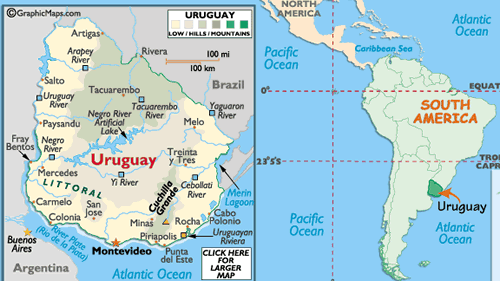
As you can see from the map below (again, special thanks to WorldAtlas.com always having the most rockin' maps), Uruguay is in South America, on the southeast side of the continent. It shares borders with Brazil and Argentina. Being on the other side of the Equator, their seasons are opposite those in the States and Europe, so when it's summer here, it's winter there, and vice versa, which means that Christmas is a very different kind of celebration - no snow and lots of fireworks.


 Who lives in Uruguay?
The people of Uruguay are descendants from many different (mostly European) nations. The dominant cultures are Spanish and Italian (Spanish is the dominant language), but you'll also find French, Dutch, German, Portuguese, and others. What you won't find, though, are native people. It turns out that Spanish conquerors wiped out all the natives, which is why Uruguay, and in particular, its capital city, Montevideo, has such a European feel to it. Like Argentina, almost 88% of the population is descended from European settlers. That "melting pot" vibe also means the food in Uruguay rocks.

And that's what I'll be talking about next time: the Uruguayan food. And let me tell you, it's delicious. :) Stay tuned!